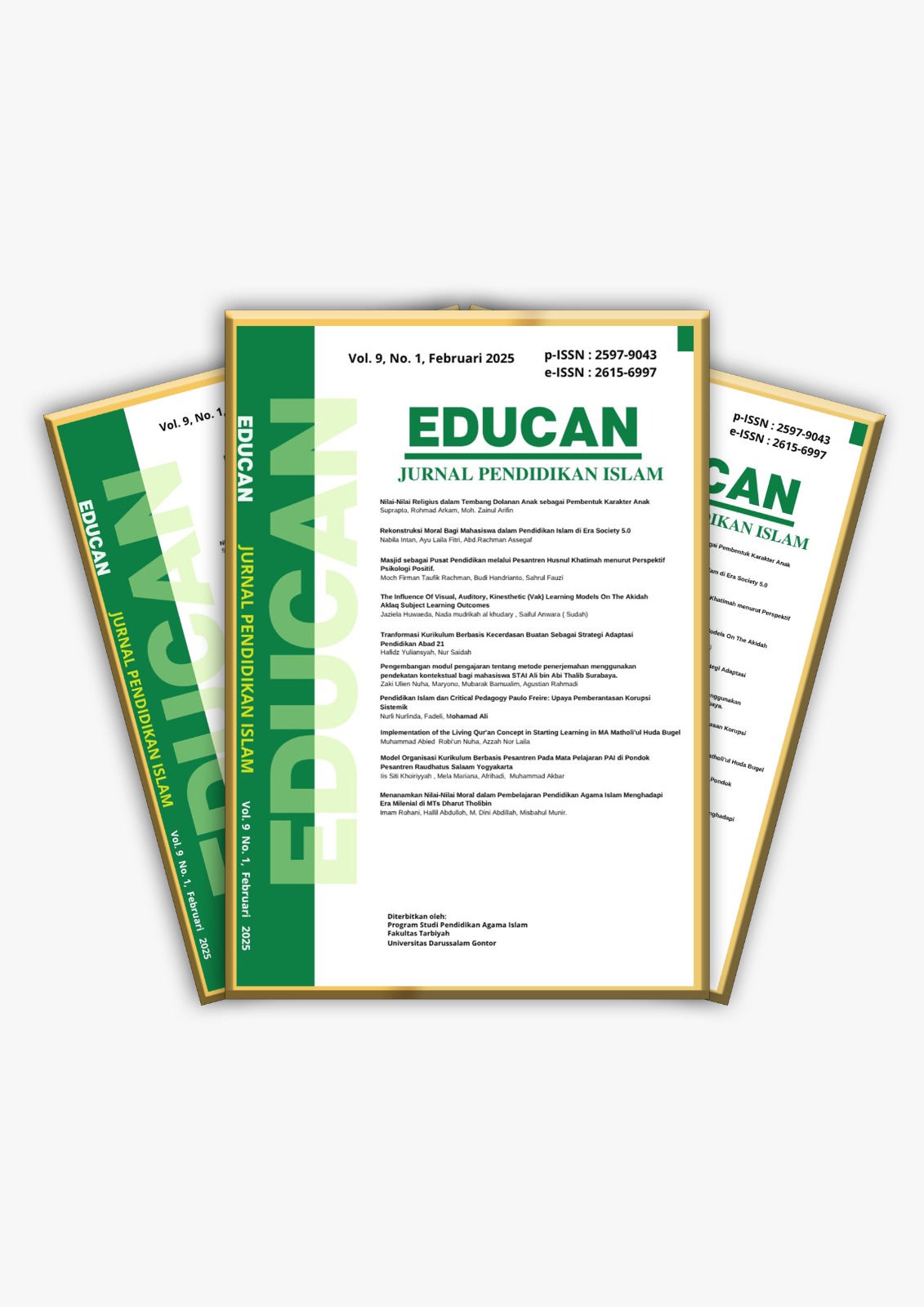
Model Organisasi Kurikulum Berbasis Pesantren Pada Mata Pelajaran PAI di Pondok Pesantren Raudhatus Salaam Yogyakarta
The Organizational Model of Pesantren-Based Curriculum in Islamic Education (PAI) Subjects at Raudhatus Salaam Islamic Boarding School, Yogyakarta
DOI:
https://doi.org/10.21111/educan.v9i1.53Kata Kunci:
Curriculum Organization Model, Integrated Curriculum, Islamic Education, Pesantren.Abstrak
This study aims to examine the curriculum organization model based on pesantren in Islamic Education (PAI) subjects at Raudhatus Salaam Islamic Boarding School, Yogyakarta. The curriculum, as a systematic educational program, plays a significant role in shaping students' character and competencies, particularly in the modern era, which demands a balance between religious and academic education. This research employs a qualitative approach with a descriptive analysis method. Data were collected through observations, interviews, and documentation, then analyzed using the interactive model of Miles, Huberman, and Saldana. The findings reveal that the PAI curriculum in this boarding school adopts an integrated curriculum model, combining the Ministry of National Education curriculum and the Kulliyatu-l-Mu’allimin Al-Islamiyah curriculum from the Modern Islamic Boarding School Darussalam Gontor. This approach fosters synergy between national academic education and the unique Islamic education of pesantren. The model is relevant for further development in the context of Islamic education in Indonesia, especially in addressing the challenge of integrating religious values with formal education requirements. This study contributes to the development of a more adaptive pesantren curriculum design, offering practical solutions for Islamic educational institutions to address contemporary challenges.
Referensi
Dewey, Jhon. 1916. Democracy and Education: An Introduction to the Philosophy of Education. New York: Macmillan.
Gagne, Robert M. 1985. The Conditions of Learning. New York: Holt, Rinehart and Winston.
Janah, Futihatul, Fuad Mafatichul Asror, dan Eko Purnomo. 2022. “Kurikulum Pendidikan Islam: Hakikat Dan Komponen Pengembangannya.” Kuttab 6, no. 2: 249. https://doi.org/10.30736/ktb.v6i2.1144.
Miles, Matthew B., A. M. Huberman, dan Johnny Saldaña. 2014. Qualitative data analysis: a methods sourcebook. 3rd ed. Thousand Oaks, Califorinia: SAGE Publications.
Nasution. 2014. Asas-asas kurikulum. Jakarta: Bumi Aksara.
Stiggins, Richard J. 2004. Student-involved Assessment for Learning. Upper Saddle River: Prentice Hall.
Sulaiman, Sulaiman. 2013. “Pola Modern Organisasi Pengembangan Kurikulum.” Jurnal Ilmiah Didaktika 14, no. 1 : https://doi.org/10.22373/jid.v14i1.489.
Taba, Hilda. 1962.Curriculum Development: Theory and Practice. Harcourt.
Tyler, Ralph W. 1949. Basic Principles of Curriculum and Instruction. Chicago: University of Chicago Press.
Widodo, Hendro. 2023. Pengembangan Kurikulum PAI. Yogyakarta: UAD Press.
Unduhan
Telah diserahkan
Diterbitkan
Cara Mengutip
Terbitan
Bagian
Lisensi
1. PROPOSED POLICY FOR JOURNALS THAT OFFER OPEN ACCESS
Authors who publish with this journal agree to the following terms:
- Authors retain copyright and grant the journal right of first publication with the work simultaneously licensed under a Creative Commons Attribution License that allows others to share the work with an acknowledgement of the work's authorship and initial publication in this journal.
- Authors are able to enter into separate, additional contractual arrangements for the non-exclusive distribution of the journal's published version of the work (e.g., post it to an institutional repository or publish it in a book), with an acknowledgement of its initial publication in this journal.
- Authors are permitted and encouraged to post their work online (e.g., in institutional repositories or on their website) prior to and during the submission process, as it can lead to productive exchanges, as well as earlier and greater citation of published work (See The Effect of Open Access).
2. PROPOSED POLICY FOR JOURNALS THAT OFFER DELAYED OPEN ACCESS
Authors who publish with this journal agree to the following terms:
- Authors retain copyright and grant the journal right of first publication, with the work [SPECIFY PERIOD OF TIME] after publication simultaneously licensed under aCreative Commons Attribution License that allows others to share the work with an acknowledgement of the work's authorship and initial publication in this journal
- Authors are able to enter into separate, additional contractual arrangements for the non-exclusive distribution of the journal's published version of the work (e.g., post it to an institutional repository or publish it in a book), with an acknowledgement of its initial publication in this journal.
- Authors are permitted and encouraged to post their work online (e.g., in institutional repositories or on their website) prior to and during the submission process, as it can lead to productive exchanges, as well as earlier and greater citation of published work (See The Effect of Open Access).