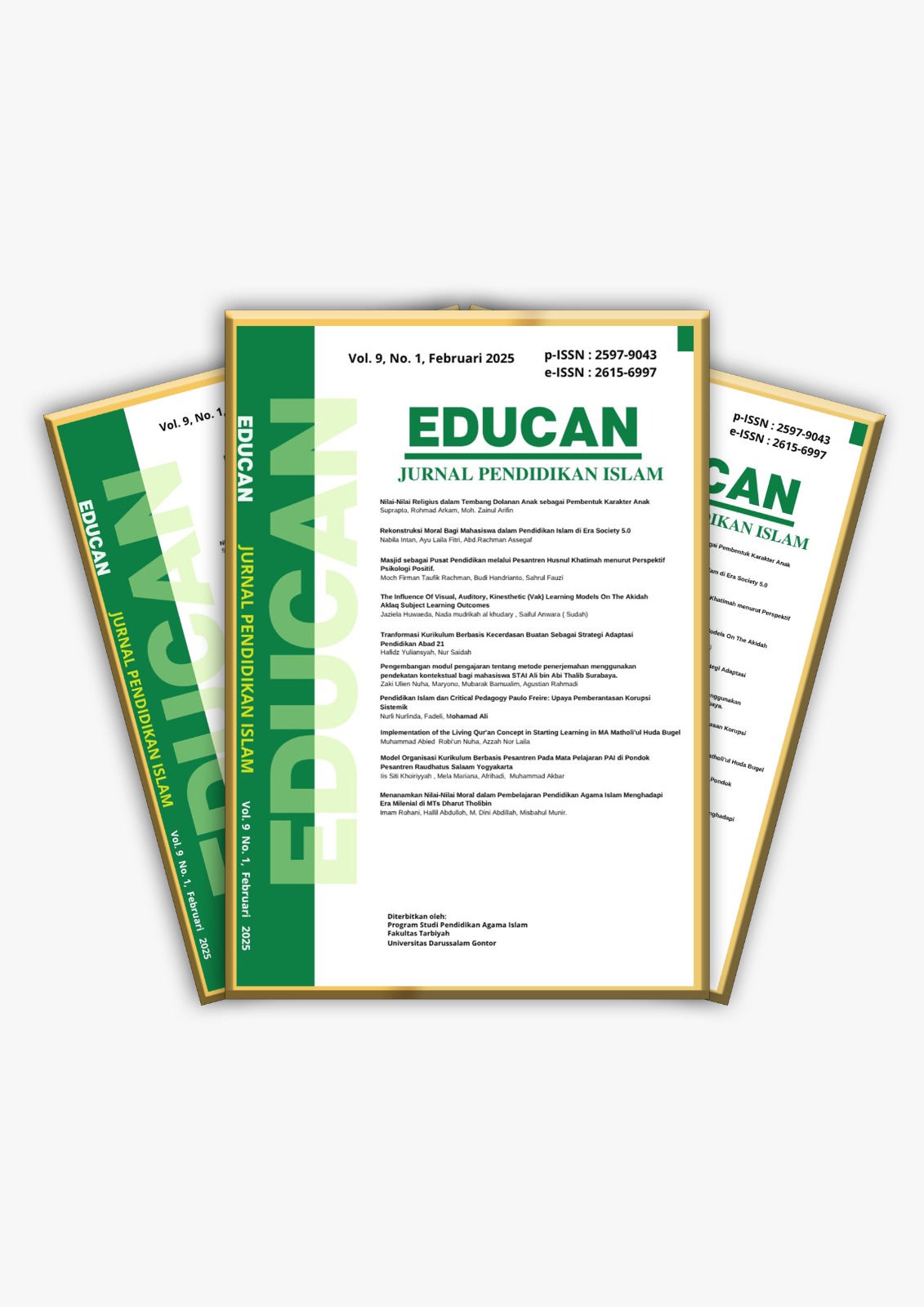
Pendidikan Islam dan Critical Pedagogy Paulo Freire: Upaya Pemberantasan Korupsi Sistemik
Islamic Education and Paulo Freire's Critical Pedagogy: Efforts to Eradiate Systemic Corruption
Keywords:
Islamic Education, Critical Pedagogy, Systemic CorruptionAbstract
Corruption in Indonesia is believed to have become an entrenched part of the social structure. Indonesia Corruption Watch reported that the number of corruption cases throughout 2023 reached the highest level in the past five years, with potential state losses amounting to IDR 28.4 trillion. Corruption damages the values of integrity and national identity, leading to a systematic decline in the quality of human behavior if left unaddressed. Efforts within the field of Islamic education have been carried out through character education aimed at shaping individuals who reject corruption. However, individual-based efforts alone are insufficient to eradicate systemic corruption. This study develops an anti-corruption education approach that not only cultivates individual morality but also promotes collective movements against corruption through the integration of Paulo Freire’s Critical Pedagogy theory with Islamic education. This study employs a qualitative method with descriptive, interpretative, and conceptual analytical approaches. The relationship between corruption, social structure, and the role of Islamic education is analyzed descriptively. Interpretative and conceptual analyses are conducted on Paulo Freire’s Critical Pedagogy theory and the values of Islamic education derived from the Qur’an and Hadith to formulate an anti-corruption education concept relevant to the Indonesian context.
References
Abdur Rafi, A. F. 2006. Terapi penyakit korupsi: Dengan tazkiyatun nafs (penyucian jiwa). Republika. Retrieved from https://lib.ui.ac.id/detail?id=86328&lokasi=lokal
Fakih, M., Topatimasang, R., & Rahardjo, T. (Eds.). 2010. Pendidikan popular: Membangun kesadaran kritis. Jogjkarta: Insist Press.
Karianga, H. 2020. Law reform and improving asset recovery in Indonesia: Contemporary approach. Journal of Law, Policy and Globalization. https://doi.org/10.7176/JLPG/93-15
Kementerian Sekretariat Negara Republik Indonesia. 2015. Keteladanan pemimpin pemegang kekuasaan, kunci Indonesia bebas dari korupsi. Retrieved from https://setneg.go.id/baca/index/keteladanan_pemimpin_pemegang_kekuasaan_kunci_indonesia_bebas_dari_korupsi
Nuraini, L., Af’idah, I. N., & Nadliratul Afrida, F. 2024. Pendidikan karakter anti korupsi perspektif pemikiran Kiai Sahal: Implikasinya pada perguruan tinggi pesantren anggota IKPI. Purworejo, Margoyoso, Pati, Jawa Tengah.
Puji Astuti, P. A. 2013. Politik korupsi: Kendala sistemik pemberantasan korupsi di Indonesia. Politika: Jurnal Ilmu Politik, 2(1), 5–17. https://doi.org/10.14710/politika.2.1.2011.5-17
Putra, N. R., & Linda, R. 2022. Korupsi di Indonesia: Tantangan perubahan sosial. Integritas: Jurnal Antikorupsi, 8(1), 13–24. Retrieved from https://jurnal.kpk.go.id/index.php/integritas
Ramli, S. 2017. Maqāmāt tasawuf dan terapi anti korupsi: Studi alternatif pemberantasan korupsi di Indonesia. Jurnal Studi Al-Qur’an, 13(2), 195–215. https://doi.org/10.21009/JSQ.013.2.05
Seregig, I. K., Suryanto, T., Hartono, B., Rivai, E., & Prasetyawati, E. (2019). Preventing the acts of corruption through legal community education. Journal of Social Studies Education Research, 9(2), 138–159. Retrieved from https://dergipark.org.tr/en/pub/jsser/issue/37944/438288
Solikin, N. (n.d.). Integrasi hukum Islam dalam pendidikan anti korupsi di Indonesia (Dissertation). Program Studi Dirasah Islamiyah pada Pascasarjana UIN Sunan Ampel Surabaya.
Suryaningsi, S., & Mula, T. 2020. The review of corruption eradication in Indonesia based on the aspect of juridical, morality, and ideology of Pancasila. Awang Long Law Review, 2(2), 93–106. https://doi.org/10.5281/zenodo.3902201
Yudho, W., & Tjandrasari, H. 2017. Efektivitas hukum dalam masyarakat. Jurnal Hukum & Pembangunan, 17(1), 57. https://doi.org/10.21143/jhp.vol17.no1.1227
Rochman, A. (2018). The Values of Social Education in Scouting Activities in Darussalam Gontor Islamic Boarding School for Campus 2. EDUCAN : JURNAL PENDIDIKAN ISLAM, 2(2), 138–162. https://doi.org/10.21111/educan.v2i2.3554
Downloads
Submitted
Published
How to Cite
Issue
Section
License
1. PROPOSED POLICY FOR JOURNALS THAT OFFER OPEN ACCESS
Authors who publish with this journal agree to the following terms:
- Authors retain copyright and grant the journal right of first publication with the work simultaneously licensed under a Creative Commons Attribution License that allows others to share the work with an acknowledgement of the work's authorship and initial publication in this journal.
- Authors are able to enter into separate, additional contractual arrangements for the non-exclusive distribution of the journal's published version of the work (e.g., post it to an institutional repository or publish it in a book), with an acknowledgement of its initial publication in this journal.
- Authors are permitted and encouraged to post their work online (e.g., in institutional repositories or on their website) prior to and during the submission process, as it can lead to productive exchanges, as well as earlier and greater citation of published work (See The Effect of Open Access).
2. PROPOSED POLICY FOR JOURNALS THAT OFFER DELAYED OPEN ACCESS
Authors who publish with this journal agree to the following terms:
- Authors retain copyright and grant the journal right of first publication, with the work [SPECIFY PERIOD OF TIME] after publication simultaneously licensed under aCreative Commons Attribution License that allows others to share the work with an acknowledgement of the work's authorship and initial publication in this journal
- Authors are able to enter into separate, additional contractual arrangements for the non-exclusive distribution of the journal's published version of the work (e.g., post it to an institutional repository or publish it in a book), with an acknowledgement of its initial publication in this journal.
- Authors are permitted and encouraged to post their work online (e.g., in institutional repositories or on their website) prior to and during the submission process, as it can lead to productive exchanges, as well as earlier and greater citation of published work (See The Effect of Open Access).